
Before you stop. If you drink heavily or every day, talk to a doctor before you stop. Stopping suddenly can bring on withdrawal that needs medical care.
Find your day
Bodies vary, so read each day as a rough landmark. Type the number of days since your last drink and the timeline highlights the finding that matches.
The first week
The body starts adjusting within hours. Sleep, heart rate and mood can feel rough before they feel better, and the research shows why.
-
1 Day
Your body starts clearing out
The alcohol leaves and your brain begins rebalancing its calming (GABA) and excitatory (glutamate) chemistry. Sleep may feel rough tonight; that recalibration is the first real step.
-
2 Days
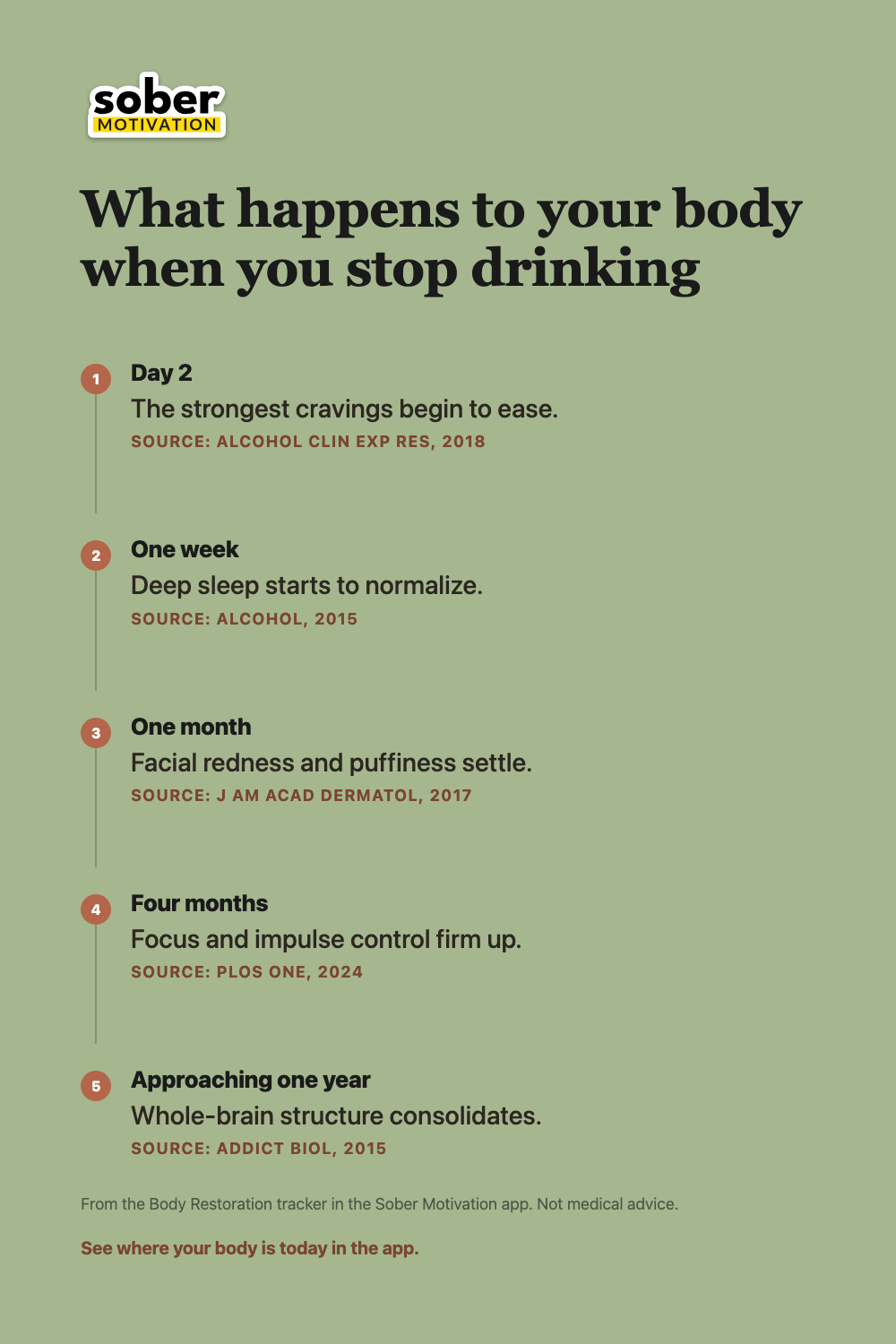
The strongest cravings begin to ease
Cravings are most intense right at the start, then step down over the first days. The slope of that decline is itself a predictor of long-term success.
Source: PMC5832597 (opens in a new tab)
-
3 Days
Dreams come back, sometimes vividly
As alcohol stops suppressing REM sleep, it rebounds, often as intense, vivid dreams. It is a sign the system is switching back on, and it settles.
Source: PMC6879503 (opens in a new tab)
-
4 Days
The peak passes
A racing heart, higher blood pressure, and restlessness peak around now as your nervous system rebalances, then begin to fall. Heavy daily drinkers should clear this window with clinical support.
-
5 Days
Your calming chemistry climbs back
GABA, the brain's natural brake, rises measurably by about three days, part of why the first days feel jittery and then start to settle.
Source: PMC7953366 (opens in a new tab)
-
6 Days
Your marrow makes blood cells again
Freed from alcohol's suppression, bone marrow clears the earliest toxic changes and platelet production rebounds within days.
Source: PMC6826798 (opens in a new tab)
-
7 Days
Deep sleep starts to normalize
Even while REM stays elevated, your deep (non-REM) sleep returns toward normal within about four days, the first restorative-sleep foothold.
Source: PMC4427543 (opens in a new tab)
Weeks two to four
Liver, gut and brain repair picks up speed in this stretch, and the first month closes with some of the biggest measured gains.
-
8 Days
New brain cells begin forming
About a week in, the memory center kicks off a surge of new cell growth that keeps arriving over the next month.
-
9 Days
Inflammation alarms quiet down
Key inflammation signals like IL-6 drop noticeably within about a week as your body stops fighting the daily damage from alcohol.
Source: PMC8292967 (opens in a new tab)
-
10 Days
Liver injury markers start falling
Within your first week the injury enzymes your liver spills into your blood (AST and ALT) already begin dropping, an early sign it is getting a break.
Source: PMC7197820 (opens in a new tab)
-
11 Days
Your repair fertilizer rises
BDNF, a protein that helps grow and repair brain connections, starts climbing within the first week and keeps rising for months.
Source: PMC10039723 (opens in a new tab)
-
12 Days
Your blood sugar settles
One week off alcohol lowers fasting blood sugar about 7% and improves how your liver handles insulin.
Source: PMC5220444 (opens in a new tab)
-
13 Days
Liver cells rebuild their machinery
Deep inside your liver cells, the sorting-and-delivery machinery alcohol jams up reorganizes and returns to normal within about a week.
Source: PMC6316505 (opens in a new tab)
-
2 Weeks
The raw irritability lifts
The anger and edginess of the first days tend to settle fastest, usually easing within the first week or two.
Source: PMC12519049 (opens in a new tab)
-
2 Weeks
Fatty liver can clear
Fat that recent heavy drinking packed into your liver can fully clear in as little as ten days, with no lasting scar.
Source: PMC12701993 (opens in a new tab)
-
2 Weeks
Your gut absorbs nutrients again
Alcohol blocks your intestine from taking up folate and B-vitamins; within about two weeks of stopping and eating well, that absorption starts to recover.
Source: PMC10096942 (opens in a new tab)
-
2 Weeks
Your brain tissue starts bouncing back
Just two weeks in, scans can already pick up brain tissue beginning to regrow, the earliest reliably imaged structural rebound.
Source: PMC5984169 (opens in a new tab)
-
3 Weeks
Your body clock resets
Around two weeks, the natural melatonin rhythm that makes you sleepy at night begins returning to its normal pattern.
-
3 Weeks
The bacterial-toxin flood drops
As the gut lining seals, the bacterial toxins leaking into your blood, and the inflammation they drive, fall week over week.
Source: PMC5493657 (opens in a new tab)
-
3 Weeks
Your brain's energy use ramps up
Brain glucose metabolism recovers mostly between days 16 and 30, especially in the frontal lobe that runs planning and decisions.
-
3 Weeks
Your mental scratchpad sharpens
Working memory, holding a phone number or a step in a recipe in mind, is one of the first skills back, often within about two and a half weeks.
Source: PMC5540274 (opens in a new tab)
-
3 Weeks
Hormone balance starts correcting
In your first sober days the carrier proteins that manage your sex hormones already begin returning toward normal, an early chemical reset.
-
3 Weeks
The over-excited chemistry settles
The hot, over-excited glutamate signaling behind early anxiety and cravings returns to a normal level by around two weeks.
Source: PMC4712074 (opens in a new tab)
-
3 Weeks
Leaky gut seals back up
Over about three weeks the intestinal barrier that heavy drinking loosens can return completely to normal, healthy tightness.
-
4 Weeks
Your bone-building switches on
Within two to three weeks, a key bone-formation signal (osteocalcin) returns toward normal as your body starts rebuilding bone.
-
4 Weeks
Immunity is still catching up
At around three weeks your immune system can still be running below normal, so healing is real but not finished, and this is exactly when staying the course matters most.
Source: PMC5660633 (opens in a new tab)
-
4 Weeks
Fatty liver fully resolves
For most people, simple alcohol-related fatty liver clears completely after two to three weeks, with liver tissue looking normal again under the microscope.
Source: PMC8041137 (opens in a new tab)
-
4 Weeks
Damaged nerves begin repairing
If drinking left your hands or feet tingling or numb, the nerves start their slow repair within the first month, even before you feel it.
-
4 Weeks
Anxiety and low mood lift for most
By around three weeks, most people see anxiety and depression drop clearly. Some need more time and support, which is completely normal.
Source: PMC12098805 (opens in a new tab)
-
1 Month
Facial redness and puffiness settle
Alcohol dilates facial blood vessels and drives puffiness, so being alcohol-free gives the flushing and under-eye swelling room to calm down.
Source: PMC5438297 (opens in a new tab)
Months two and three
Change slows down and settles into the body's regular rhythm. Blood, hormones and mood all show measurable movement.
-
1 Month
Your kidneys re-tune their chemistry
Within about a month, the kidney's fine-tuning of salts and minerals can reset itself, even after years of heavy drinking.
-
1 Month
The biggest month for your brain
The first 30 days do the heavy lifting: roughly half of your brain's total tissue recovery happens in the first month, led by the frontal lobe.
Source: PMC4345147 (opens in a new tab)
-
1 Month
One dry month resets your metabolism
A single alcohol-free month drops insulin resistance about 26%, lowers blood pressure, trims weight, and cuts cancer-linked growth factors sharply.
-
1 Month
GGT keeps falling
GGT, the enzyme most sensitive to alcohol, keeps falling at a month and can take longer if it started very high, so do not be discouraged by the pace.
Source: PMC6876406 (opens in a new tab)
-
1 Month
Your blood pressure drops and holds
One month proven abstinence lowers 24-hour blood pressure by roughly 7 points systolic and 6 diastolic, a durable win for your heart and stroke risk.
-
1 Month
Muscle weakness starts to reverse
Your muscles switch the protein-building machinery back on, and mild alcohol-related weakness begins reversing over the first weeks.
Source: PMC5513686 (opens in a new tab)
-
1 Month
Triglycerides fall
Elevated blood fats (triglycerides) come down over roughly two to four weeks, and your LDL shifts toward a healthier particle size.
-
2 Months
Your stomach lining heals
The raw, inflamed stomach lining alcohol kept irritated settles and repairs over your first weeks alcohol-free.
Source: PMC6826790 (opens in a new tab)
-
2 Months
Building outpaces breakdown
By around two months, bone formation keeps climbing and the earlier imbalance between building and losing bone starts to even out.
-
2 Months
Testosterone climbs back in men
Around the three-week mark and onward, testosterone starts rising again, part of why energy, mood, and drive often return in the first sober months.
-
2 Months
The heaviness lifts
Unlike cravings, general low or heavy feelings ease gradually rather than overnight, reaching near-baseline for most people by about nine weeks.
Source: PMC5832597 (opens in a new tab)
-
2 Months
Steadier on your feet
Much of the balance and gait you regain shows up in the early weeks; balance-focused exercise genuinely helps it along.
Source: PMC3465531 (opens in a new tab)
-
3 Months
Healthy-sized red blood cells return
Over about three to four months your body replaces the enlarged red cells alcohol made with normal ones, one of the clearest lab signs of blood recovery.
Source: PMC6826798 (opens in a new tab)
-
3 Months
Fertility markers rebound
Sperm quality can recover remarkably fast, returning toward normal within about three months of stopping, even after heavy drinking.
-
3 Months
Reward wiring rebuilds, slowly
The brain's dopamine reward receptors recover more slowly than mood does, over many months, which is why pleasure and motivation can feel flat early and why steady support matters.
-
3 Months
Cravings become rare
By around the hundred-day mark, cravings occur on far fewer days and the risk of returning to drinking has dropped toward its low, steady baseline.
Source: PMC5832597 (opens in a new tab)
Months four to twelve
Focus, heart rhythm and deeper inflammation keep improving, and the first year ends with a clearer head.
-
4 Months
Deep sleep keeps rebuilding
Restorative slow-wave sleep continues recovering across the first several months, a gradual climb rather than a switch, so trust the direction.
Source: PMC6879503 (opens in a new tab)
-
4 Months
Your heart's recovery gear returns
Around four months, resting heart rate settles and heart rate variability (your nervous system's calm-and-recover balance) measurably rises.
Source: PMC4465836 (opens in a new tab)
-
4 Months
Focus and impulse control firm up
Sustained focus and the ability to hit the brakes on impulses show clear gains across the 6-to-12-month window, and they are worth the wait.
Source: PMC10760842 (opens in a new tab)
-
5 Months
Desire and intimacy improve
Sexual desire, arousal, and satisfaction measurably improve with sobriety for both women and men, and even a short stretch moves the needle.
-
5 Months
Deeper inflammation keeps settling
Over six months to a year, sustained sobriety lets deeper inflammation calm and your immune cells rebalance toward a healthier state.
Source: PMC5548491 (opens in a new tab)
-
5 Months
Nerve recovery is well underway
Around the half-year mark, tingling and numbness continue to fade for many people, especially paired with good nutrition and B-vitamins.
-
6 Months
Bone mass holds and rebuilds
Around six months, staying alcohol-free lets bone mass hold steady or start to rebuild, while continued drinking keeps eroding it.
-
6 Months
Your repair signal reaches full strength
By around six months, sustained sobriety brings BDNF, your brain-repair chemistry, all the way back to healthy levels, something that does not happen if drinking continues.
-
6 Months
Your outlook lifts
Many people feel a real lift in mood, self-esteem, and emotional steadiness beginning around the 6-to-12-month mark.
-
7 Months
Memory approaches baseline
Both word-based and picture-based memory come back strongly from about six to eight months on.
Source: PMC10760842 (opens in a new tab)
-
7 Months
A weakened heart regains strength
For a heart weakened by alcohol, sustained sobriety can begin restoring its pumping strength within about six months.
-
8 Months
Your thinking layer thickens back
By around seven months, the brain's outer thinking layer has thickened back so much it is statistically indistinguishable from non-drinkers in most regions.
Source: PMC10902196 (opens in a new tab)
-
8 Months
Irregular rhythms ease
Cutting alcohol sharply reduces episodes of atrial fibrillation and how much time your heart spends in that racing, irregular rhythm.
-
9 Months
Strength keeps climbing
Over your first several months to a year, deeper muscle changes from years of drinking resolve and measured grip strength keeps climbing.
-
9 Months
Your pancreas is protected
Over months sober, your pancreas holds onto more of its enzyme-making ability, and you are far more likely to stay pain-free.
Source: PMC6826792 (opens in a new tab)
-
10 Months
Whole-brain structure consolidates
Gray and white matter across many regions have grown back and the fluid spaces that had enlarged have shrunk toward normal.
Source: PMC4345147 (opens in a new tab)
-
11 Months
Vision can recover
If heavy drinking dimmed or blurred your vision, sobriety plus good nutrition can bring a striking amount of it back over the first year or two.
Source: PMC4008906 (opens in a new tab)
-
12 Months
The fog has lifted
Around the one-year mark, most of the mental fog is gone and your memory, focus, and problem-solving test close to baseline.
-
1 Year
Even scar tissue can regress
With a year or more sober, even liver scar tissue (fibrosis) can begin to regress for many people. Healing continues well beyond year one.
Year two and beyond
Recovery has no finish line at year one. The research keeps finding gains in brain wiring, the heart, the liver and long-term health risks.
-
1 Year
Every year makes the next easier
The odds of returning to drinking fall steeply with time in recovery; by your second year they are far below the early days.
-
1.1 Years
Your wiring keeps re-insulating
Past your first year, the connections between brain regions keep repairing, and staying sober actually reverses the direction of brain aging in your white matter.
Source: PMC4750405 (opens in a new tab)
-
1.2 Years
The slow finishers keep improving
A few of the most demanding skills, complex planning and long-term visual memory, are still catching up past a year, and they keep improving.
Source: PMC10760842 (opens in a new tab)
-
1.3 Years
A damaged heart can fully recover
With a full year-plus of sobriety, a heart weakened by alcohol can recover much or all of its pumping function, if you started before permanent scarring.
Source: PMC11231944 (opens in a new tab)
-
1.5 Years
Denser bone on a scan
Give it a year or two alcohol-free and measurable bone density can actually recover at the spine and hip.
-
1.6 Years
Even advanced livers can regenerate
The liver is uniquely able to regenerate. Long-term sobriety can let even advanced, scarred livers recover function once thought lost.
Source: PMC12954922 (opens in a new tab)
-
1.8 Years
Your heart's payoff compounds
Cutting alcohol keeps paying your heart back: in heavy drinkers who stop, serious heart events fall by nearly a quarter, with the gap widening after about three years.
Source: PMC10979316 (opens in a new tab)
-
1.9 Years
Long-term visual memory returns
Long-term visual memory is the marathon of recovery, still catching up at the one-year mark and typically restored by around two years.
Source: PMC10760842 (opens in a new tab)
-
2 Years
Your lifespan odds improve most
Sustained abstinence brings the single largest drop in death risk of any change a heavy drinker can make.
Source: PMC4634361 (opens in a new tab)
-
2.1 Years
Pancreatitis risk keeps dropping
Staying sober after a pancreatitis attack is the strongest thing you can do to keep it from coming back, cutting recurrence toward zero.
-
2.7 Years
Stroke risk falls year over year
Staying alcohol-free lowers your long-term risk of stroke, a benefit that compounds the longer you stay sober.
-
3 Years
Robust, lasting brain recovery
By three years the major brain recovery is well established, with white-matter integrity still slowly improving. Most abilities test as normal.
Source: PMC4750405 (opens in a new tab)
-
4 Years
Frontal blood flow finishes recovering
Blood flow to the brain's self-control regions keeps improving for years; full frontal recovery is documented in people past about four years sober.
Source: PMC4040978 (opens in a new tab)
-
5 Years
Nearly all thinking tests as normal
After a few years sober, nearly all of your thinking, memory, attention, and reasoning test as normal. The picture is a brain that comes back.
Source: PMC1868685 (opens in a new tab)
-
5 Years
Five years is a real threshold
Most people who reach five years stay sober long-term, and the year-to-year risk of returning to drinking becomes small, approaching that of the general population.
-
5.2 Years
Esophageal cancer risk drops
This one takes patience: esophageal cancer risk does not fall right away, but after five to nine sober years it has already dropped substantially and keeps falling.
-
5.8 Years
Throat and voice-box risk eases
About 15% of the excess throat-cancer risk is gone after five sober years, with more benefit as the years add up.
-
6.6 Years
Liver and colorectal risk decline
Liver-cancer risk falls roughly 6 to 7% for each sober year, and colorectal risk drops meaningfully after about 15 years. This is the reward for the long haul.
Questions people ask
How long does it take for your body to recover after you stop drinking?
Recovery starts in the first days and continues for years, and different systems move on different clocks. Within the first two weeks: Within your first week the injury enzymes your liver spills into your blood (AST and ALT) already begin dropping, an early sign it is getting a break. (Source: PMC7197820 (opens in a new tab)) Fat that recent heavy drinking packed into your liver can fully clear in as little as ten days, with no lasting scar. (Source: PMC12701993 (opens in a new tab)) By the end of the first month: A single alcohol-free month drops insulin resistance about 26%, lowers blood pressure, trims weight, and cuts cancer-linked growth factors sharply. (Source: BMJ Open PMID 29730627 (opens in a new tab))
When do alcohol cravings get easier?
Cravings are most intense right at the start, then step down over the first days. The slope of that decline is itself a predictor of long-term success. (Source: PMC5832597 (opens in a new tab)) Later on: By around the hundred-day mark, cravings occur on far fewer days and the risk of returning to drinking has dropped toward its low, steady baseline. (Source: PMC5832597 (opens in a new tab))
Does sleep get better after you quit drinking?
Sleep often gets choppy first and then improves. As alcohol stops suppressing REM sleep, it rebounds, often as intense, vivid dreams. It is a sign the system is switching back on, and it settles. (Source: PMC6879503 (opens in a new tab)) Even while REM stays elevated, your deep (non-REM) sleep returns toward normal within about four days, the first restorative-sleep foothold. (Source: PMC4427543 (opens in a new tab)) Restorative slow-wave sleep continues recovering across the first several months, a gradual climb rather than a switch, so trust the direction. (Source: PMC6879503 (opens in a new tab))
How long does it take for your liver to heal?
Fat that recent heavy drinking packed into your liver can fully clear in as little as ten days, with no lasting scar. (Source: PMC12701993 (opens in a new tab)) For most people, simple alcohol-related fatty liver clears completely after two to three weeks, with liver tissue looking normal again under the microscope. (Source: PMC8041137 (opens in a new tab)) With a year or more sober, even liver scar tissue (fibrosis) can begin to regress for many people. Healing continues well beyond year one. (Source: PMID 24414184 (opens in a new tab))
When does brain fog lift?
The first 30 days do the heavy lifting: roughly half of your brain's total tissue recovery happens in the first month, led by the frontal lobe. (Source: PMC4345147 (opens in a new tab)) Around the one-year mark, most of the mental fog is gone and your memory, focus, and problem-solving test close to baseline. (Source: PMID 22264351 (opens in a new tab))
Is it safe to stop drinking suddenly?
If you drink heavily or every day, talk to a doctor before you stop. Stopping suddenly can bring on withdrawal that needs medical care. A racing heart, higher blood pressure, and restlessness peak around now as your nervous system rebalances, then begin to fall. Heavy daily drinkers should clear this window with clinical support. (Source: StatPearls NBK441882 (opens in a new tab))
See where your body is today
The Body Restoration tracker in the Sober Motivation app shows the finding for your sober day, with its source one tap away.
Get the appOpens the App Store or Google Play on your phone, and sobermotivation.net on a computer.